Rental logistics and delivery preparation · 5 minute read
How to prepare your site for delivery day
Almost every delivery problem we see is a five-minute fix if it is raised the day before, and a rescheduled delivery if it is discovered when the truck arrives.
Here is exactly what we need from a site, and what to check before your delivery date.
The truck has to reach the spot
Units are delivered on a flatbed or service truck, not carried by hand across a property. As a practical rule, the truck needs roughly 12 feet of width and about 12 to 14 feet of overhead clearance along the whole route in — and it needs to be able to get back out again.
The clearance issues that catch people out are rarely the obvious ones: low branches over a driveway, a narrow gate frame, a soft verge next to a firm-looking lane, or a turning circle that works for a car and not for a truck.
- Clear vehicles from the delivery route and the placement spot the night before
- Cut back overhanging branches along the approach
- Unlock gates, or tell us where the key is and who has it
- Flag low power lines, septic lids, irrigation heads and buried utilities
Ground conditions matter more than people expect
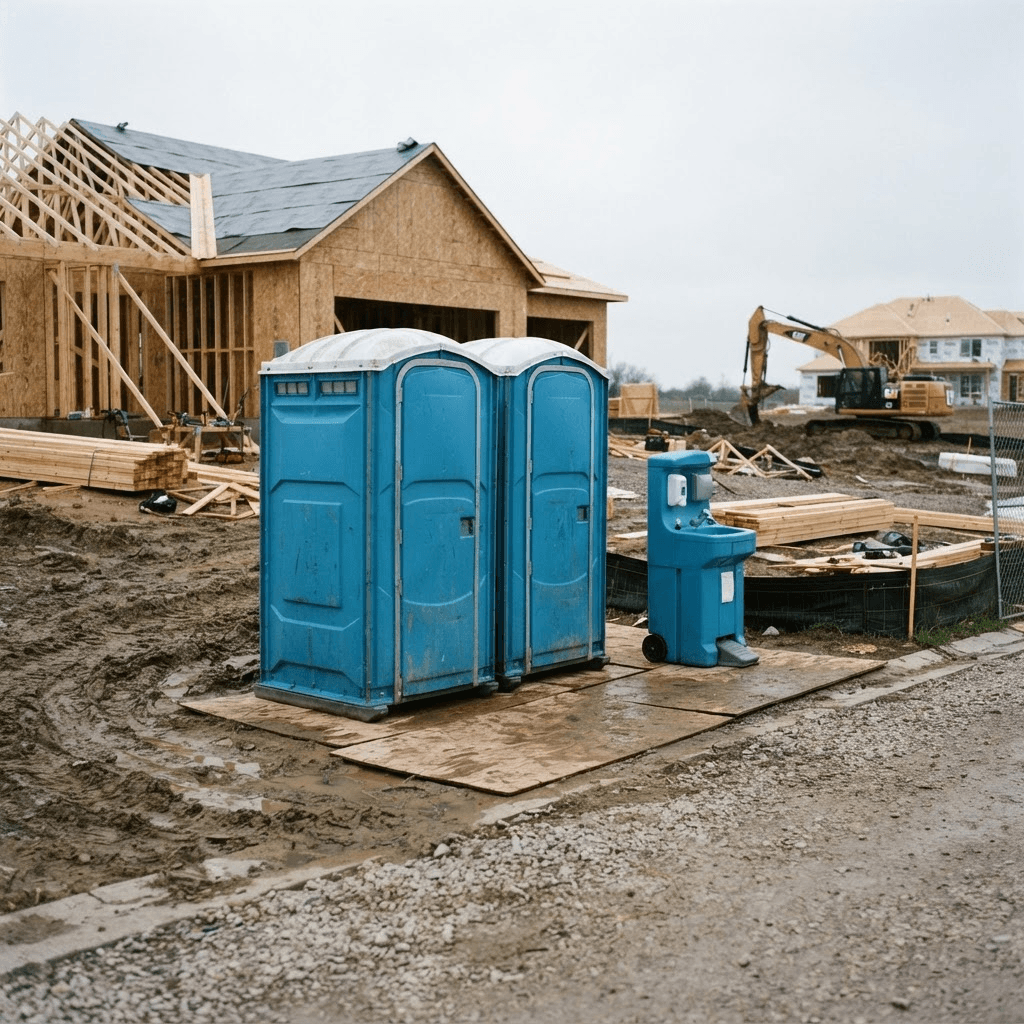
A portable restroom needs firm, reasonably level ground. Level is a safety issue — a unit on a slope is unpleasant to use and, in the worst case, can tip. Firm is an access issue: a loaded service truck that reaches a unit in dry September may not reach the same spot in March.
In this part of Ohio the freeze-thaw cycle and spring mud are the real constraints. Gravel, asphalt, compacted dirt and firm turf are all fine. Soft lawn after heavy rain, fresh fill and unstabilised mud are not. Plywood or a gravel pad under the unit solves most of it cheaply.
Choosing where the unit goes
That last point is the one most often missed. A spot that is reachable on delivery day may be enclosed by scaffolding, fencing or parked vehicles a week later — and then it cannot be serviced or collected.
- Close enough to be genuinely convenient — if it is a long walk, it will not get used
- Off the main sightline at an event, but not hidden somewhere unlit or unsafe
- Away from doors, food service and dining areas
- With the door facing away from foot traffic and the prevailing wind
- Accessible units on level ground with a clear, step-free approach
- Reachable by the service truck without moving anything, for the whole rental period
Wind, shade and the Ohio summer
Units are stable, but they are light when empty and they catch wind like a sail. On exposed sites — lakefront, open fields, high ground — placement against a building, hedge or fence line makes a real difference, and units can be staked or weighted where needed.
Shade is worth thinking about in July and August. A unit in direct sun all day is measurably less pleasant, and the smell is worse. Avoid parking it against a south-facing wall if you have a choice.
Permission and permits
If the unit will sit on a street, sidewalk, public park or any land you do not control, check with the city before you book. Requirements vary between Mentor, Painesville, Willoughby and the townships, and it is the site owner or event organiser who is responsible for securing any permission required — not the rental company.
On private property, make sure whoever owns it knows the unit is coming and has agreed to where it will sit.
On the day
Someone who knows the plan should be reachable by phone. Ninety percent of delivery calls are a driver asking a thirty-second question — which corner, which side of the gate, is the far end firm enough. An unanswered phone turns that into a guess or a return trip.
Once the unit is placed, do not move it. They are heavier and more awkward than they look, and a unit relocated by hand is usually no longer level. Call us instead; relocating a unit is a normal request.
Want this applied to your job?
Describe the site and the dates and we will do the sizing with you, out loud, including the parts we are unsure about.